
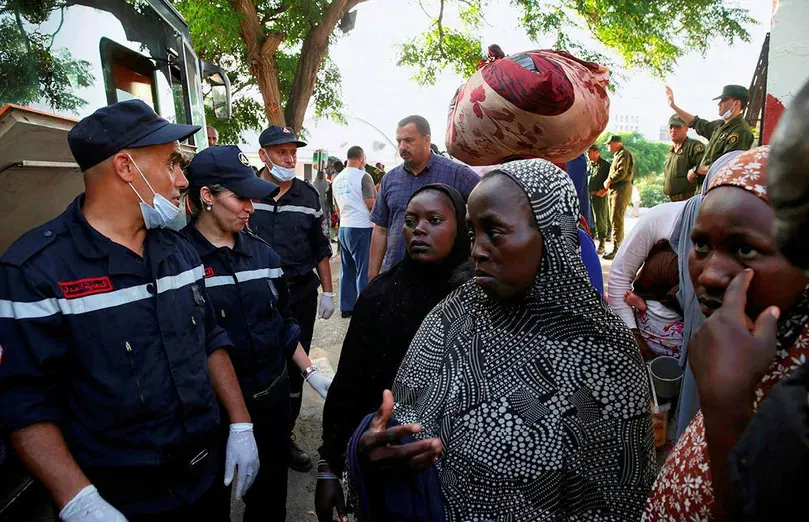
Algiers, 24 November 2025—PRESS AFRICA— Algeria, a crossroads country between the Sahel, the Maghreb and the Mediterranean, has for more than a decade welcomed a growing number of sub-Saharan nationals. They come from Mali, Niger, Chad, Cameroon, Côte d'Ivoire, Guinea and several other countries in West and Central Africa. Some are merely in transit to Europe, but others settle temporarily or long-term in Algeria's major cities.
While the country remains one of the region's most attractive economic hubs, the lives of Black Africans in Algeria are still marked by numerous socioeconomic and security challenges, often exacerbated by migration tensions and social perceptions.
A mixed welcome: individual hospitality, collective social pressure
In daily life, many Black Africans report receiving gestures of solidarity, particularly in working-class neighborhoods, markets and mosques.
But at the same time, the collective perception remains ambivalent, fueled in particular by the visible increase in migration flows, social anxiety aggravated by the economic crisis, a lack of public policy to regulate migration, and cultural and linguistic tensions.
This duality (individual hospitality, institutional rigidity) creates a fragile coexistence, in which sub-Saharan migrants and residents adapt as best they can.
Economic precarity: the reality of odd jobs
For the majority, professional integration remains very difficult. Without a clear legal status, opportunities are often limited to informal work such as cleaning, handling, security guarding and other construction-related jobs. These poorly paid jobs expose workers, among other things, to exploitation by certain intermediaries, wages that are sometimes unpaid, long and arduous days, and a total lack of social protection. According to several local NGOs, this vulnerability is aggravated by the impossibility of obtaining official contracts, which creates strong economic dependence.
Housing, between squalor and instability
Access to decent housing is one of the biggest obstacles.
Many live in shared rooms, in buildings under construction, in outlying neighborhoods or in informal rentals that are particularly expensive. This precarity is heightened by a lack of recognized identity documents, the mistrust or reluctance of some landlords and, above all, the fear of evictions, which are sometimes sudden.
Difficult access to healthcare
Living conditions, often cramped and insecure, weaken families and isolated workers. Although hospital emergency rooms can take in anyone in distress, the reality is more complex for Black Africans, who face limited access to the health system, sometimes prohibitive care costs, a lack of insurance and isolated discrimination in some facilities. For many migrants, self-medication or recourse to community networks remains common.
Racism and discrimination: a reality still present
The subject is sensitive, but impossible to ignore. Several Black Africans report insults in the street, job refusals linked to skin color, frequent police checks and isolated assaults, sometimes serious. Even though part of society firmly condemns such behavior, racial discrimination does exist, fueled by migration tensions, mutual cultural ignorance, certain representations inherited from the past and polarizing media discourse. Algerian and international associations are working to raise public awareness, but the road remains long.
The question of expulsions and police checks
One of the most controversial issues concerns operations to round up sub-Saharan migrants and return them to the country's southern borders, notably those with Niger. These operations, denounced by some NGOs, are sparking a national debate. For the state, the aim is to control irregular migration flows and guarantee security. For associations, these practices lack transparency and endanger vulnerable people.
A resilient community, organized around mutual aid networks
Faced with hardship, Black Africans settled in Algeria rely on powerful community networks, religious groups (churches, African mosques), digital platforms and informal associations that facilitate employment, housing and moral support. This resilience partly explains why some are able to put down lasting roots in the social fabric.
The situation of Black Africans in Algeria reflects a continental phenomenon: the transformation of migration routes, the recomposition of African identities and the tensions generated by the globalization of movement.
While gestures of solidarity and citizen initiatives exist, difficulties remain numerous. Algeria, a hinge country between Black Africa and the Maghreb, has the opportunity to become a model of welcome and coexistence. But this transformation will require sustained institutional, social and cultural efforts.
Writer: Saïd TESSILIMI
Leave a Comment