
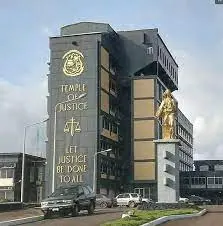
Monrovia, 6 November 2025—PRESS AFRICA— The Republic of Liberia, founded in West Africa, has a singular political trajectory: its very early birth as an independent state, a long period of domination by a so-called "Americo-Liberian" elite, followed by a radical overthrow with devastating civil wars, and then a return to democratic elections. This article traces that history from independence to the present day.
From colony to independence (1822-1847)
Liberia has its roots in the initiative of the American Colonization Society (ACS), which, as early as 1816, advocated the "return" of free African Americans to Africa. In 1822, the first groups of African Americans arrived on the West African coast in what would become Liberia. On 26 July 1847, the declaration of independence of the Republic of Liberia was adopted.
Liberia then adopted a constitution modeled on that of the United States, and elected Joseph Jenkins Roberts as its first president. Thus, unlike most African states, Liberia did not go through the classic stages of European colonization followed by decolonization: it proclaimed itself independent very early, in a unique context.
Americo-Liberian hegemony and apparent stability (1847-1970)
After independence, a group of African American emigrants and their descendants, the Americo-Liberians, dominated the country's political and economic apparatus. The dominant party for a long time was the True Whig Party, which controlled the presidency and government for much of the 20th century. The country enjoyed relative formal stability and international recognition, while depending heavily on exports of rubber, iron ore and other commodities.
Nevertheless, this stability was partly superficial: power was concentrated in the hands of a minority (Americo-Liberians), while indigenous populations had limited access to senior posts, and even to the right to vote until belated reforms.
The turning point of 1980 and the fall of the old order
A major turning point came on 12 April 1980: a coup led by Samuel K. Doe, then a master sergeant of Krahn origin, ended Americo-Liberian domination and the regime of William R. Tolbert Jr. Doe became head of state through the "People's Redemption Council," initiating a new political order marked by militarization and ethnic tensions. In 1986, a new constitution was adopted and multiparty elections were held, although they were contested.
The civil wars (1989-2003)
Liberia plunged into a period of major conflict. In December 1989, the rebellion of the National Patriotic Front of Liberia (NPFL), led by Charles Taylor, launched an insurgency against Doe's regime. The conflict lasted until 1997, causing hundreds of thousands of deaths, mass displacement and the partial collapse of the Liberian state.
After Charles Taylor's election in 1997, a second civil war broke out, before the conflict ended in 2003 with Taylor's exile and the establishment of a transitional government.
Toward reconstruction and renewed democracy (2003-2025)
The post-war period marks a turning point. The Truth and Reconciliation Commission (Liberia) was created in 2005 to investigate abuses during the conflicts and to recommend institutional reforms. In November 2005, Ellen Johnson Sirleaf was elected president, becoming the first woman head of state in Africa. She focused on reconstruction, debt and international relations.
In 2018, the election of George Weah was hailed as Liberia's first peaceful transfer of power since 1944. In 2024, Joseph Boakai was sworn in as president, marking a new stage.
Challenges and outlook
Despite progress, several challenges persist. The consolidation of the rule of law and democratic governance remains fragile after decades of war. The trauma of the civil wars and questions of transitional justice (for example, the establishment of a war crimes court in 2024) have yet to be addressed. Liberia's economy must overcome dependence on raw materials, a weak public sector, and a need for infrastructure and human capital. The memory of the divide between Americo-Liberians and indigenous populations continues to influence social and political dynamics.
Liberia's political history is that of a highly atypical trajectory: an African state created by free African Americans, which declared its independence as early as 1847. For more than a century it experienced elite domination, before a coup in 1980 triggered years of civil war. Since the 2000s, the country has been attempting a return to democracy, peace and reconstruction, even though the challenges remain heavy. Liberia thus embodies both the potential and the fragilities of a nation-state in Africa: rich in its unique history, but faced with the need to turn that history into stability and sustainable development.
Writer: Saïd TESSILIMI

Leave a Comment