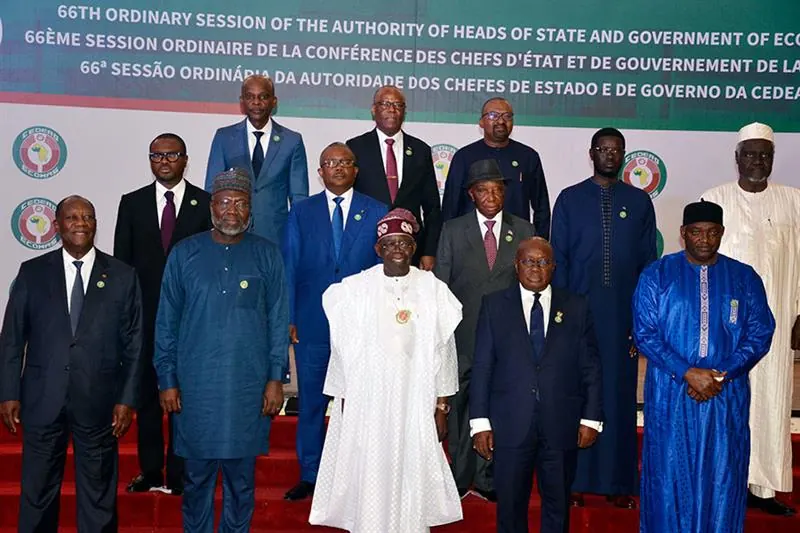
Abuja, 6 November 2025 —PRESS AFRICA— Fifty years after its creation, the Economic Community of West African States (ECOWAS) is going through one of the most critical periods of its existence. Born in 1975 with the promise of regional integration based on solidarity, free movement and peace, the organisation today struggles to maintain its unity in the face of political and geopolitical upheaval in the region.
A community losing cohesion
The recent withdrawals of Mali, Burkina Faso and Niger, made official in 2024, have deeply shaken the institution. These three countries, now united in the Alliance of Sahel States (AES), accuse ECOWAS of having become an instrument of foreign interference, too far removed from African realities. This rift marks an unprecedented break in the history of the community, which was founded precisely on the idea of a common West African destiny.
Contested sanctions and weakened leadership
The sanctions imposed on the sub-region's military regimes have crystallised criticism. While ECOWAS wanted to defend democratic principles, its economic measures have often penalised populations more than the leaders targeted. In several countries, voices are being raised to denounce an institution that is "disconnected" and "partial".
Internal divisions also weaken its authority. Between Nigeria's economic priorities, Ghana's diplomatic ambitions and Senegal's caution, it is hard to impose a common line. ECOWAS thus struggles to speak with one voice on major issues, from terrorism to regional trade.
Economic integration at a standstill
Economically, the ambition of a common market is struggling to materialise. Despite decades of discussion, the regional single currency, the ECO, remains at the project stage. Borders remain obstacles to trade, bureaucracy hampers the movement of goods, and development inequalities between member states complicate any harmonisation.
The promise of economic integration based on the free movement of people and capital now seems compromised by the return of protectionism and political tensions.
Security: a challenge that goes beyond states
On security, ECOWAS faces a succession of crises that imperil its credibility. From the jihadist threat in the Sahel to instability in Guinea and Sierra Leone, the region remains one of the most exposed on the continent.
The ECOWAS Standby Force, created precisely to respond quickly to regional threats, remains barely operational for lack of logistical means and political coordination. External interventions, whether African or international, tend to replace regional action, relegating ECOWAS to an advisory role.
A necessary overhaul
Faced with this situation, several analysts are calling for a deep overhaul of the organisation. For Ivorian political scientist Yao Kouassi, "ECOWAS must once again become a community of peoples, not just a conference of heads of state." He argues for a refocusing on regional priorities: youth employment, food security and infrastructure development.
Other observers believe ECOWAS should draw inspiration from the model of the African Continental Free Trade Area (AfCFTA), favouring concrete, measurable economic projects over political declarations.
An institution at a crossroads
At a time when West Africa is redefining itself politically and geostrategically, ECOWAS finds itself at a crossroads. Its survival will depend on its ability to reinvent itself, to restore the confidence of its members and to reconnect with the aspirations of West African citizens. For more than a simple regional organisation, ECOWAS remains the symbol of an ideal: that of a united and sovereign West Africa. It remains to be seen whether that ideal can still be realised.

Leave a Comment