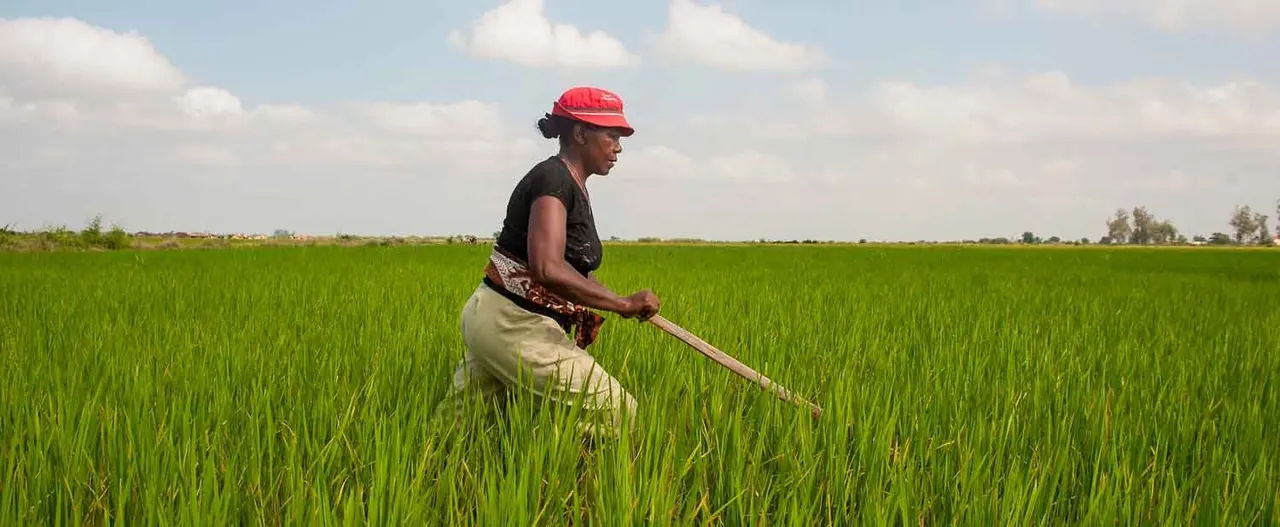
Maputo, 19 November 2025—PRESS AFRICA— Mozambique, rich in fertile land and a climate well suited to agricultural production, remains a country where the land feeds both the population and the economy. In 2025, agriculture remains one of the main levers of national development, accounting for about 23% of gross domestic product (GDP) and employing nearly 70% of the working population. Yet despite its potential, the sector is struggling to modernise and to take full advantage of its resources.
A sector vital to economic and social stability
According to data from Mozambique's Ministry of Agriculture and Rural Development, the country has 36 million hectares of arable land, of which less than 20% is currently farmed. The main crops are maize, cassava, rice, cotton, sugar cane and cashew nuts, the latter being one of the country's flagship export products.
"Agriculture is the backbone of our economy. It guarantees food security and supports the incomes of millions of Mozambicans," Celso Correia, the Minister of Agriculture, said recently.
In rural areas, notably in the provinces of Nampula, Sofala and Zambezia, family farming dominates, accounting for more than 90% of national food production.
A solid but vulnerable contribution
Although agriculture contributes greatly to Mozambique's GDP growth, it remains heavily dependent on climate hazards. Floods, droughts and cyclones — such as Idai in 2019 and Freddy in 2023 — have underlined the fragility of the Mozambican farming model, which is still little mechanised and insufficiently irrigated.
In 2024, agricultural losses linked to natural disasters were estimated at more than $200 million, affecting thousands of smallholders. This reliance on rainfall explains the low average productivity, estimated at 1.2 tonnes of maize per hectare, compared with more than 4 tonnes in neighbouring South Africa.
Modernisation efforts under way
The government has launched several programmes to strengthen the sector's resilience, notably the National Agricultural Investment Plan (PNIA II 2021-2025), supported by the African Development Bank and the FAO. The plan aims to increase productivity, diversify crops and promote sustainable irrigation.
Foreign investment is also beginning to grow in agribusiness and local value chains, notably in cashew nut processing and sugar production.
Digital farming cooperative projects have emerged in the northern provinces, enabling farmers to access urban markets and obtain credit through mobile platforms.
"We want to move from subsistence farming to commercial agriculture, capable of creating jobs and generating competitive exports," President Filipe Nyusi said in a speech delivered in Beira in October 2025.
Persistent challenges: infrastructure, financing and training
Despite this progress, several obstacles still hold back the sector's transformation. The lack of infrastructure — rural roads, warehouses, irrigation systems — raises costs and limits access to markets.
Agricultural financing also remains a major problem: less than 5% of national bank loans go to farmers, for lack of sufficient collateral. In addition, technical training and agricultural extension services remain inadequate to meet farmers' needs.
Farmers' organisations are demanding a better policy of support for smallholders, notably targeted subsidies and a reduction in taxes on inputs.
Towards sustainable and inclusive agriculture
Faced with climate and socio-economic challenges, Mozambique is seeking to build a more resilient, inclusive and sustainable agriculture. Local initiatives around agroecology and organic farming are multiplying, backed by NGOs and international partners.
The country is also betting on new agricultural technologies, such as drones for land mapping and mobile apps for crop management. These innovations offer a glimmer of hope for a new generation of farmers who are more connected and productive.
Mozambican agriculture remains an essential pillar of the national economy and a key factor of social stability. Its contribution to GDP remains vital, but its potential is still largely under-exploited. For the sector to play its full role as an engine of development, Mozambique will need to step up mechanisation, strengthen land tenure security and diversify its agricultural exports. Between tradition and modernity, the country is at a turning point: that of transforming its agriculture into a genuine lever for sustainable and shared growth.
Reporter: Saïd TESSILIMI
Leave a Comment